Pirmadienis, lapkričio 02 d.







Colours, sacred motifs, geometry, nature and the symbolism of traditional pattern-making
Indian and Native American folk art emerge from distinct cultural histories, spiritual traditions and relationships with the natural world. Yet, when placed side by side, they reveal fascinating visual affinities. Both artistic traditions often transform everyday materials, plants, animals, celestial bodies and sacred symbols into richly decorative visual languages.
Their similarities can be especially striking in their use of colour, repetition, symmetry, geometric ornamentation and symbolic imagery. These connections offer an opportunity to explore a shared human fascination with nature, spirituality, cycles of life and the relationship between the visible and invisible worlds.
It is important, however, to understand that neither Indian nor Native American art represents a single uniform style. India contains hundreds of regional folk-art traditions, while Native American art encompasses many distinct nations and communities. The comparisons below are visual and thematic, rather than claims of a common origin.
One of the most noticeable similarities is the importance of colours inspired by the natural environment.
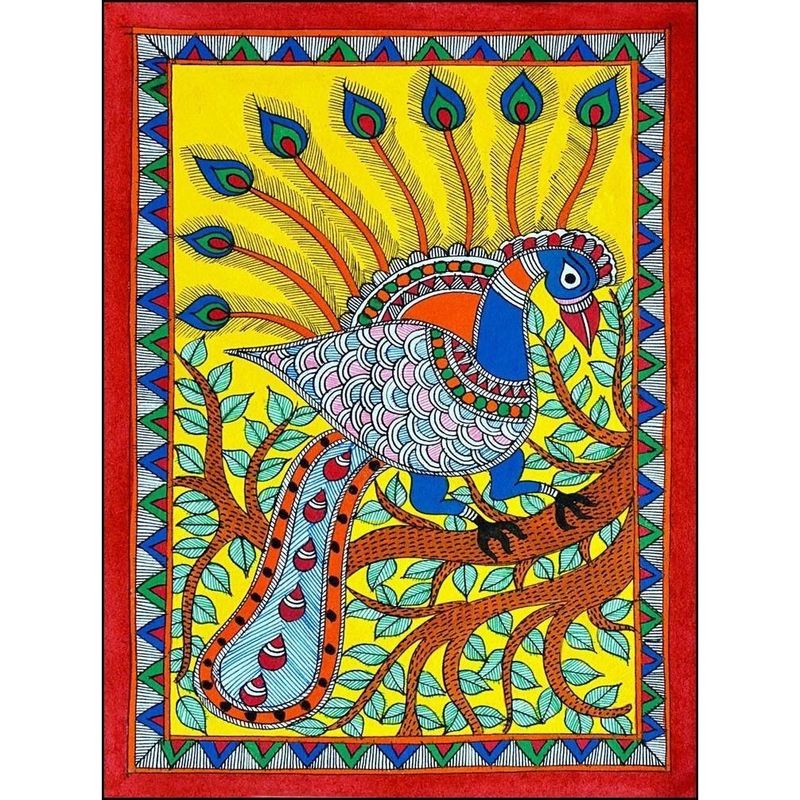
In Indian folk art, particularly Madhubani (Mithila), Gond and Pattachitra painting, artists frequently use vivid combinations of yellow, red, orange, blue, green, black and white. Traditional Madhubani pigments could be obtained from turmeric, indigo, flowers, leaves, soot and other natural materials. These colours create strong contrasts and give the compositions an almost luminous quality.
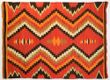
In Native American art, particularly Diné (Navajo) weaving and Plains beadwork, we also find striking combinations of red, yellow, blue, white, black and earthy browns. These colours appear in textiles, beadwork, pottery and painted hide objects. Their meanings vary considerably between communities and individual designs.
For example, historical Diné textiles often use bold contrasts and repeated geometric colour bands, while Plains beadwork makes use of vivid colour arrangements to create highly structured decorative compositions.
The visual connection: Both traditions can create a powerful dialogue between warm and cool colours:
Golden yellow and orange evoke sunlight, warmth and vitality.
Deep blue and turquoise evoke the sky, water and expansive landscapes.
Red and terracotta connect the artwork visually to earth and organic materials.
Black and white create contrast, rhythm and definition.
Green introduces plants, fertility and the living natural world.
This combination of saturated yellow, deep blue, terracotta and white is particularly interesting when developing a contemporary artwork inspired by both traditions.

Nature is one of the richest sources of imagery in both artistic worlds.
Indian folk art frequently depicts:
The sun and moon as celestial forces.
Birds, fish, elephants, deer and peacocks.
Flowers, leaves, trees and vines.
Sacred plants such as the tulsi.
Rivers, mountains and other natural elements.
In Madhubani painting, animals, birds and flowers frequently fill the composition, while Gond art is particularly known for transforming animals, trees and other living forms into intricate arrangements of lines, dots and repeated patterns.
Native American visual traditions also contain an extraordinary vocabulary of natural forms. Depending on the community and medium, artists represent birds, animals, plants, clouds, mountains, water and celestial phenomena.
For example, Diné weaving often translates the surrounding landscape into geometric forms, while floral and geometric beadwork traditions of Cherokee, Creek and Seminole artists intertwine plant-inspired and abstract patterns.
The visual connection: Both traditions demonstrate how nature can become more than decoration. It becomes a visual language through which people express their relationship with the environment, their ancestors, spiritual beliefs and the cycles of life.

Geometric pattern-making is another fascinating area of comparison.
Indian folk art uses:
Concentric circles.
Triangles and diamonds.
Repeated dots and lines.
Spirals and wave-like forms.
Symmetrical floral arrangements.
Decorative borders and repetitive ornamentation.
Warli painting, for example, is built around simple geometric shapes. Human figures are often constructed from triangles and circles, while scenes of dancing, farming and community life create rhythmic circular compositions. Madhubani painting also uses dense line work and repeating decorative patterns to fill the entire surface.
In Native American art, geometric structures are especially visible in Diné textiles, Plains beadwork and painted parfleche containers.
Common visual forms include:
Diamonds and nested diamonds.
Zigzag lines.
Triangles and stepped shapes.
Horizontal and vertical bands.
Concentric circles.
Repeating angular borders.
These structures are visible in historical Diné weaving and Plains beadwork, although the meanings of individual designs are specific to their cultural contexts.
The visual connection: Both traditions use repetition to create rhythm, movement and visual harmony. A simple geometric element can become a complex ornamental field through multiplication, rotation, mirroring and layering.
This is particularly interesting from an Art Nouveau perspective, where flowing organic lines can be combined with geometric structures.
Circular imagery is particularly interesting when comparing these traditions.
In Indian art, the circle appears in mandalas, solar imagery, ritual decorations, floral compositions and representations of cosmic order. The mandala is especially important in several Indian religious and artistic traditions, where its geometry can express relationships between the human and cosmic worlds.
In some Plains Indigenous traditions, circular imagery also has profound significance. A cross within a circle, for example, can represent the world, its four directions and a sacred centre. This is documented in Cheyenne beadwork in the collection of the Cleveland Museum of Art.
The important distinction is that similar shapes do not necessarily carry identical meanings.
The visual connection: Circular compositions, radiating lines, concentric arrangements and celestial imagery can create a sense of wholeness, continuity and cosmic movement.
Another striking similarity is the importance of the frame and border.
Indian folk paintings often cover the entire surface with ornamentation. Flowers, leaves, small animals, geometric details and decorative lines fill the spaces around the central figures.
Native American textiles, beadwork and painted objects also frequently use carefully organized borders, repeated motifs and contrasting bands.
Both approaches create a visual structure in which the central image and its surrounding ornamentation work together.
There is also a shared appreciation for the beauty of repetition: a single flower, diamond, triangle or line can be transformed into an elaborate visual system.
Both artistic traditions are closely connected to storytelling.
Indian folk painting frequently depicts Hindu mythology, local legends, festivals, marriage ceremonies, village life and relationships between humans and animals.
Native American artistic traditions also preserve cultural narratives, histories, relationships with the land, ceremonial knowledge and community identity.
However, the role of imagery varies greatly between communities. Some designs are decorative, some are personal, some communicate cultural knowledge, and others have specific ceremonial significance.
The important similarity is that traditional art is not simply about creating beautiful objects. It can preserve knowledge and transmit cultural identity across generations.
The following table summarizes the similarities that can be explored when studying the two traditions.
|
Visual element |
Indian folk art |
Native American art |
|---|---|---|
|
Colours |
Yellow, red, orange, blue, green, white |
Red, yellow, blue, black, white, earth tones |
|
Geometry |
Circles, triangles, diamonds |
Diamonds, triangles, circles, zigzags |
|
Nature |
Flowers, trees, fish, birds, animals |
Animals, plants, birds, clouds, landscapes |
|
Composition |
Dense ornamentation, symmetry |
Repeated geometry, bands, structured ornamentation |
|
Borders |
Floral and geometric frames |
Geometric bands and repeated motifs |
|
Celestial imagery |
Sun, moon, stars, mandalas |
Sun, celestial imagery and directional symbolism in particular traditions |
|
Materials |
Natural pigments, handmade paper, walls, textiles |
Wool, hide, plant dyes, beads, pottery |
The similarities between Indian and Native American folk art offer a fascinating starting point for contemporary visual experimentation.
A contemporary artwork could explore:
Colour: Bright marigold yellow, golden ochre, cobalt blue, turquoise, terracotta and ivory.
Botanical elements: Marigolds, lotus flowers, leaves, vines and stylized blossoms.
Geometry: Concentric circles, diamonds, triangles, spirals and repeated lines.
Composition: Symmetrical arrangements, decorative frames and densely patterned backgrounds.
Celestial imagery: Sun discs, moons, stars and radiating halos.
Organic movement: Flowing plants, water, feathers and curving botanical lines.
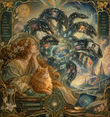
Art Nouveau could provide an interesting bridge between these visual languages. Its flowing botanical lines, ornamental frames, elongated figures and decorative symmetry can complement the dense patterns of Madhubani and Gond painting, as well as the geometric structures found in particular Indigenous North American textile and beadwork traditions.
It is important to avoid treating sacred or community-specific Indigenous symbols as interchangeable decorative elements. A respectful contemporary interpretation should identify its artistic references and preserve the cultural context of particular motifs.
Indian and Native American folk art demonstrate how human communities transform their surroundings into visual languages. Despite their different histories, geographies and spiritual traditions, both contain rich traditions of colour, geometry, natural imagery, repetition and symbolic storytelling.
Their visual affinities are especially apparent in the use of vivid earth-inspired palettes, rhythmic patterns, symmetrical compositions and the transformation of plants, animals and celestial forms into decorative imagery.
What makes these traditions particularly interesting together is the relationship between geometry and organic life: the flower becomes a pattern, the animal becomes a rhythmic composition, the sun becomes a circle, and the landscape becomes an arrangement of lines and colours.
Rather than suggesting that the two traditions are identical, we can appreciate how they independently developed sophisticated visual systems through which nature, spirituality and cultural memory become art.
These are useful institutional sources for further study and for illustrating the article:
1. Government of Bihar – Madhubani Painting: Traditional pigments, motifs, techniques and subject matter.
2. Denver Art Museum – Indigenous Arts of North America: Indigenous artistic traditions, beadwork and cultural context.
3. Cleveland Museum of Art – Diné Wearing Blanket: Geometric weaving, colour and landscape references.
4. Smithsonian National Museum of the American Indian – Parfleche Landscape: Geometric abstraction and bold colour.
5. University of Missouri – Plains Indian Beadwork: Historical geometric motifs and beadwork techniques.
6. Chicago Public Library – Warli and Madhubani Art: Geometric forms and Indian folk-art comparisons.

Visas autorines teises saugo įstatymas. Dėl tekstų publikavimo prašome kreiptis į redakciją. Redakcija adreso ir savininkų neturi. Tekstus ar jų dalis publikuoti neatsiklausus redakcijos draudžiama, tai padaryti galima tik gavus redakcijos leidimą. Radikaliai.lt redakcija tekstų negrąžina, nenaikina, neredaguoja. Honoraras autoriams nemokamas. Radikaliai.lt leidžiamas nemokamai. Visos fotografijos publikuojamos gavus jų savininkų leidimus. Jei po fotografija neparašyta, kas jos savininkas, vadinasi, jis yra kalbinama grupė ar muzikantas (ir pan.). Visos pretenzijos dėl nuotraukų autorystės bus sprendžiamos tik taikiu keliu.
© radikaliai.lt 2011–2025 | Kontaktai