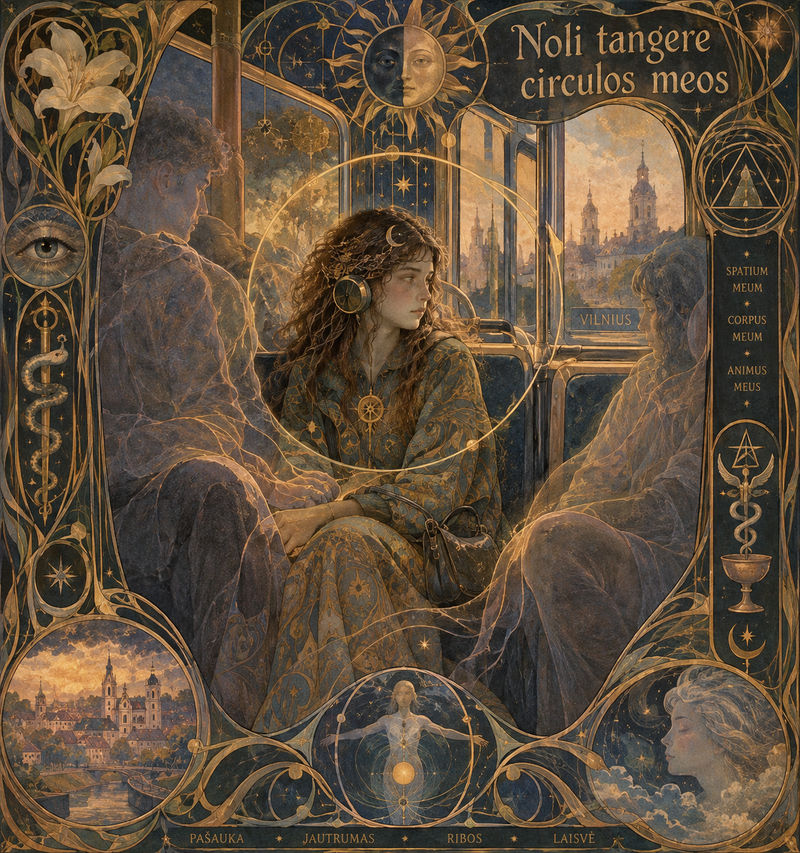
Noli tangere circulos meos
Onutė Gaidamavičiūtė
2026 m. Spalio 08 d., 11:57
Skaityta: 11 k.
Here is a reflective essay that focuses on sensory discomfort, personal boundaries, and the experience of navigating public transport as an autistic person.
Noli tangere circulos meos
Noli tangere circulos meos — “Do not touch my circles.” The phrase may sound strange at first, but for me, it describes something deeply important: the invisible space around my body that helps me feel safe.
As an autistic girl travelling on public transport in Vilnius, I sometimes experience this invisible space being crossed without anyone realizing how uncomfortable it makes me. I might sit alone on a bus or trolleybus, quietly looking through the window, listening to music, or simply trying to stay calm after a long day. When there is an empty seat beside me, I expect that there will be at least a little space between my body and another passenger.
But sometimes someone sits down beside me even when there are other possibilities, or the vehicle becomes crowded and a person's leg, knee, hip, or body presses against mine. Sometimes it is a man, sometimes a woman. It may be completely accidental. They may not even notice that they are touching me.
Yet I notice.
For many people, a small touch like a leg brushing against another person's leg may seem insignificant. They might simply move a little and forget about it. For me, it can be much harder to ignore. The physical sensation can become the only thing I can think about. Instead of concentrating on my journey, I become aware of where their body is, where my body is, and whether we are going to touch again.
It can create an awkward feeling that is difficult to explain. I may freeze rather than move away. I may not know whether I am supposed to say something. I may worry that the other person will think I am being rude or strange if I change seats. Sometimes I simply endure the discomfort until my stop arrives.
The difficulty is not necessarily that the other person has done something intentionally wrong. Public transport is a shared and sometimes crowded space. People have limited room, especially during busy hours. Accidental contact is unavoidable at times.
But knowing that something is accidental does not automatically make the sensation comfortable.
Autism can make sensory experiences more intense or difficult to filter out. A touch that another person barely notices can remain in my awareness for much longer. When someone else's leg touches mine, for example, I cannot always simply decide that it does not matter. My attention can become fixed on that physical sensation. I might feel tense, distracted, embarrassed, or even overwhelmed.
There is also something emotionally uncomfortable about having another person's body suddenly enter my personal space. My body belongs to me. I want to be able to decide when and how I am touched. Even in a public place, I still have an invisible boundary around myself.
I call that boundary my circle.
My circle is not a demand that nobody ever sit near me. It is not a belief that other passengers are bad people. It is simply the space in which I can feel comfortable and in control of my own body.
Sometimes circumstances make the circle smaller. A crowded bus may leave almost no space at all. I understand that. But when there is room, I appreciate when people leave a little distance between us. That small amount of space can make a surprisingly large difference.
Perhaps the most important thing is that personal boundaries are not always visible. Someone may look perfectly calm while feeling extremely uncomfortable inside. An autistic person may not show distress in a way that others recognize. They may stay silent, avoid eye contact, or simply sit still. Silence does not necessarily mean that everything feels fine.
Public transport belongs to everyone. We all have to share it with strangers, and sometimes our personal circles will inevitably overlap. Still, a little awareness and consideration can make travelling easier for everyone.
So when I think Noli tangere circulos meos, I am not saying, “Never come near me.”
I am saying: “Please remember that there is a person inside this space. Please notice that my body has boundaries, even if you cannot see them. And when there is a choice, please give me a little room.”
For someone else, that extra seat, that few centimetres of distance, or that decision not to press against another passenger may mean almost nothing.
For me, it can mean feeling safe enough to simply sit, breathe, and make my way home.If you want, I can also make it more emotional and literary, more academic, or more personal and autobiographical while keeping the same theme.