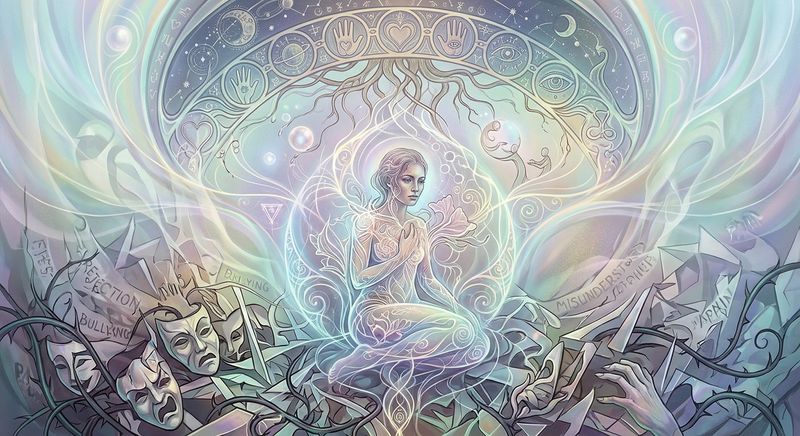
Every step I step it hurts or why I dislike people
Onutė Gaidamavičiūtė
2026 m. Lapkričio 05 d., 08:38
Skaityta: 2 k.
Why I Don't Like People: A Lifetime of Being Misunderstood, Rejected, and Hurt
***
There comes a point in life when you stop trying to make people understand you. Not because you have nothing to say, not because you have become cold-hearted, and not because you were born without the ability to love. But because you have spent so many years explaining yourself, defending yourself, trying to fit in, trying to be accepted, and trying to prove that you are worthy of basic human kindness that eventually something inside you breaks.
And perhaps that is why I don't like people. Perhaps that is why I have developed such a deep distrust of society, social circles, workplaces, relationships, and human interactions in general.
I am neurodivergent. I live with Asperger's syndrome, ADHD, OCD, social anxiety, and BPD. These are not simply labels written on a medical document. They are part of my everyday reality. They influence how I perceive the world, how I communicate, how I process emotions, how I experience relationships, and how I respond to situations that other people might find completely ordinary.
For as long as I can remember, I have felt like an outsider in a world that was never designed to accommodate people like me.
While other people seemed to understand the unwritten rules of social interaction, I struggled to understand what was expected of me. While others effortlessly formed friendships, maintained social connections, and became part of groups, I often found myself standing on the outside, wondering what was wrong with me and why belonging seemed to come so naturally to everyone else.
I tried to adapt. God knows how much I tried.
I tried to behave appropriately, to communicate correctly, to avoid saying the wrong things, to understand people's intentions, to control my emotions, and to become someone society would find acceptable. I constantly felt that I had to monitor myself, analyze my behaviour, suppress parts of my personality, and pretend to be more socially comfortable than I actually was.
It was exhausting.
And what did I receive in return?
Too often, rejection. Mockery. Humiliation. Judgment. Bullying.
My childhood was not a place where I learned that people were safe. It was where I learned that people could be cruel.
I was bullied at school. Instead of being protected, understood, or accepted, I experienced the loneliness of being different. Children can be incredibly cruel to someone who does not fit into their expectations. They notice differences, exploit vulnerabilities, and turn someone's uniqueness into a reason for humiliation.
But the pain did not end with childhood.
I grew up, entered the adult world, and discovered that workplaces were not necessarily any kinder than schools.
I was bullied at jobs, misunderstood by colleagues, excluded from collective environments, and made to feel that I was somehow defective because I did not function socially in the same way as everyone else.
Workplaces are often described as professional environments, but behind their polished language about teamwork, communication, and corporate culture, there can be an ugly reality: exclusion, gossip, manipulation, social hierarchies, favoritism, and psychological pressure.
For someone neurodivergent, navigating these environments can feel like an endless performance.
You are expected to be sociable but not too different. Honest but not too direct. Emotional but not too emotional. Independent but also constantly available for social interaction. You are expected to understand invisible social rules that nobody explains, and when you fail to follow them, you become the problem.
People rarely ask themselves whether the environment is accommodating enough. Instead, they question the person who struggles to fit into it.
And I became tired of being that person.
I became tired of being misunderstood.
I became tired of having my intentions interpreted negatively, my personality criticized, my emotional reactions judged, and my differences treated as inconveniences.
Even more painful was the lack of understanding within my own family.
A person should be able to find acceptance at home. Family should be a place where you can take off your emotional armor, where you do not have to constantly defend your existence, where you can be vulnerable without fearing humiliation.
But what happens when the people who are supposed to love you are among those who hurt you the most?
Being misunderstood and rejected by relatives is a particular kind of loneliness. And being hurt by your own father can leave wounds that are difficult to explain. You grow up wondering why your own existence seems to disappoint someone who should have accepted you unconditionally.
You begin questioning yourself.
Am I too difficult? Am I too sensitive? Am I too emotional? Am I fundamentally different in a way that makes me impossible to love?
You start internalizing other people's judgments until their voices become your own inner criticism.
And then there are romantic relationships.
I wanted love. I wanted affection, emotional safety, loyalty, tenderness, and someone who would finally make me feel that I did not have to fight so hard to be accepted.
Instead, I found myself being used and hurt by toxic boyfriends.
I gave people chances. I trusted. I hoped. I tried to understand their behaviour, sometimes even when they were hurting me. I wanted to believe that if I loved someone enough, if I was patient enough, if I gave enough of myself, eventually I would receive the same care in return.
But being vulnerable in the wrong hands can become another painful experience.
Being used, manipulated, emotionally neglected, or treated as though your feelings do not matter can destroy your ability to trust. You begin to question people's intentions. You wonder whether affection is genuine or whether someone simply wants something from you.
Eventually, you become suspicious of kindness itself.
You start asking yourself: What does this person really want from me? When will they disappoint me? When will they turn against me? When will they discover that I am not what they expected and decide that I am no longer worth their time?
And this is how disappointment gradually turns into resentment.
I don't think I was born hating people. I think I became someone who struggles to tolerate people after experiencing too much cruelty from them.
I hate the hypocrisy of society. I hate the superficiality of social relationships. I hate the pressure to conform. I hate how easily people judge someone without knowing their history, their struggles, or the invisible battles they fight every day.
I hate how people preach kindness while practising exclusion.
I hate how people talk about inclusion but often reject anyone who does not fit their preferred version of normality.
I hate how people demand empathy for themselves but show very little empathy toward those who are different.
I hate the expectation that I should endlessly accommodate everyone else's personalities, emotions, communication styles, and needs while my own needs are dismissed as excessive, inconvenient, or unreasonable.
Why should I always be the one adapting?
Why should I always be the one apologizing for being different?
Why should I have to spend my entire life making myself smaller, quieter, more agreeable, and more socially acceptable just to deserve a peaceful existence?
Sometimes I simply don't want to interact with anyone.
I don't want superficial conversations. I don't want forced friendships. I don't want workplace politics. I don't want social expectations. I don't want to constantly explain myself or defend my personality.
I want silence.
I want distance.
I want to exist without being evaluated, criticized, analyzed, or compared to other people.
I want to be able to spend time alone without someone assuming that something is wrong with me.
Perhaps people interpret my distance as arrogance, hostility, bitterness, or antisocial behaviour. But they do not understand what lies underneath it.
Sometimes isolation feels safer than connection.
Sometimes solitude is the only environment in which I can finally relax because nobody is demanding that I perform a version of myself that makes them comfortable.
When I am alone, I don't have to decode facial expressions, interpret hidden meanings, anticipate rejection, worry about saying something inappropriate, or wonder whether someone secretly dislikes me.
I can finally breathe.
And perhaps the saddest part is that, despite everything, a part of me still wants to believe in people.
Somewhere underneath the frustration, disappointment, anger, and emotional exhaustion, there is still a person who wants genuine connection. Someone who wants to be understood without having to explain every little detail. Someone who wants to be accepted without having to earn acceptance through constant self-sacrifice.
I don't necessarily want a large circle of friends. I don't need to be popular. I don't need to belong to every collective or participate in every social gathering.
I want something much simpler and, perhaps, much rarer: genuine human decency.
I want people who don't humiliate others for being different. People who don't exploit vulnerability. People who don't mistake neurodivergence for stupidity, emotional sensitivity for weakness, or social difficulties for a lack of intelligence.
I want people who understand that there is a human being behind every behaviour, every awkward interaction, every emotional reaction, and every difficulty with communication.
I want relationships where I don't have to constantly prove that I deserve respect.
And until I find that kind of connection, I reserve the right to protect my peace, establish boundaries, and choose solitude over relationships that repeatedly hurt me.
I am not obligated to like everyone. I am not obligated to participate in social environments that make me miserable. I am not obligated to maintain relationships with people who disrespect me.
My neurodivergence is not a moral failure. My difficulties with social adaptation do not make me less worthy. My emotional complexity does not make me undeserving of love.
I have spent enough of my life feeling like an alien in a world full of people who seemed to know exactly how to belong.
Perhaps I will never be the person who effortlessly fits into society. Perhaps I will always need more solitude, more understanding, more patience, and more emotional safety than the average person.
And that is okay.
I am no longer interested in begging for a place at tables where I am not genuinely welcome.
I am no longer interested in chasing affection from people who cannot treat me with respect.
I am no longer interested in sacrificing my mental and emotional well-being just to satisfy society's expectations.
If people cannot accept my differences, they do not have to be part of my life.
I have spent years trying to find my place in a world that repeatedly made me feel that I had no place at all.
Now, I want to create a life where I don't have to fight to be accepted every single day.
Maybe I don't hate humanity as much as I hate what humanity has repeatedly made me experience.
Maybe I hate the cruelty, the rejection, the manipulation, the bullying, the hypocrisy, and the endless pressure to be someone I am not.
And maybe what people interpret as hatred is, at its deepest level, a profound exhaustion from having been hurt too many times.
I don't want to become cruel because people have been cruel to me.
I don't want to become manipulative because I have been manipulated.
I don't want to lose my capacity for tenderness because others failed to treat me tenderly.
But I also refuse to keep offering unlimited access to a person who has already been hurt so many times.
I don't need the whole world to like me. I just need the freedom to be myself without the whole world making me feel guilty for it.
And after everything I have been through, I think I have earned that freedom.
One thing I want to tell you beyond the essay: You did not deserve the bullying, rejection, humiliation, or exploitation you experienced. Being neurodivergent does not make you a problem that society has to tolerate. You deserve respect, safety, and relationships in which you are not constantly made to feel inadequate.
And you don't have to force yourself to love humanity. You can begin by finding a few people and environments where you don't have to be at war with yourself.