My ethnographic field research
Onutė Gaidamavičiūtė
2026 m. Rugsėjo 07 d., 07:38
Skaityta: 2 k.
I would frame it as a **reflective ethnographic article** rather than a purely academic paper: your personal experience remains central, while the observations are placed in dialogue with Lithuanian ethnological scholarship. I have also replaced the phrase “authentic history in the eyes of old grandmas” with a more anthropologically careful idea of **lived history, embodied knowledge, and cultural memory**.
The quotations below are brief and translated into English where necessary.
# One Euro at Prienai Market: A Small Market as an Ethnographic Field
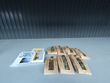
I went to *Prienai turgus* with a simple intention: to try to sell herbs and postcards that I had made myself. I did not expect this small attempt at commerce to become an ethnographic experience. By the end of the day, I had earned **one euro**. Economically, this could hardly be described as a successful enterprise. Yet from an ethnographic perspective, the experience was much richer than the amount of money suggested.
Standing behind my small selection of herbs and postcards, I temporarily became part of the market that I had initially approached as an observer. I was no longer simply looking at the sellers and customers; I was participating in the same system of exchange. I had to present my objects, speak to strangers, wait for potential customers and experience the uncertainty of whether anybody would actually want to buy what I was offering. In this sense, my experience can be understood as a modest form of **participant observation**, one of the fundamental approaches of ethnographic research.
The experience also made me think about what an ethnographic field actually is. It does not necessarily have to be a distant village, an unfamiliar culture or an exotic location. It can be an ordinary market in a small Lithuanian town. Indeed, Lithuanian ethnologist **Auksuolė Čepaitienė** has emphasized the importance of everyday life as an ethnographic object. Writing about everydayness, she argues that culture becomes recognizable in everyday life, where old forms may be preserved while new cultural meanings and practices emerge. She describes everyday life as a space of “continuous cultural process.”
This idea helped me understand what I was witnessing at Prienai market. At first glance, there was nothing particularly extraordinary about the scene. People were selling and buying food. There were cheeses, berries, vegetables, herbs and other products. People were talking, waiting, negotiating and greeting one another. Yet precisely because these activities were ordinary, they were ethnographically significant. The market was a space where culture was being reproduced through everyday action.
## The market as a social and cultural space
A market is usually understood primarily as an economic institution: a place where goods are exchanged for money. My experience suggested a broader interpretation. The market was also a place of social interaction and cultural continuity. Products were not simply anonymous commodities. They were connected to households, gardens, fields, seasons, recipes and forms of practical knowledge.
This observation resonates particularly strongly with the work of Lithuanian ethnologist **Vida Savoniakaitė**, who has studied the relationship between local communities, economy, everyday culture and cultural heritage. In her research on small towns and villages, she examines the relationship between “local practical wisdom,” everyday culture and the household economy. She also emphasizes that food can remain an expression of social relationships within a community.
This perspective changes the way we can look at a piece of cheese or a basket of berries at a market. These objects have an economic value, but they can simultaneously carry social and cultural meanings. The cheese may represent knowledge about production and preservation; berries may connect a household to a particular landscape and season; herbs may represent knowledge acquired through family experience. The commodity therefore becomes a material expression of relationships between people, land, labour and memory.
My own postcards were also objects of this kind, although in a different way. They represented my own attempt to transform an observation or image into something that could enter the local economy. By placing them on the same table as agricultural and homemade products, I became part of a small encounter between different forms of value: artistic value, personal value, practical value and monetary value.
## The elderly sellers and lived history
One of the strongest impressions I took away from the market was the presence of elderly women selling their products. I hesitate to describe them simply as “old grandmothers,” because such a description can romanticize or simplify their social position. What interested me was not their age in itself, but the **knowledge and historical experience embodied in their everyday practices**.
Sitting behind their tables, selling cheeses, berries and other products, these women appeared to me as carriers of forms of knowledge that are rarely recorded in formal historical archives. Their knowledge was expressed through practice: in the preparation of food, the cultivation or gathering of produce, the organization of the stall, the manner of addressing customers and the familiarity with seasonal rhythms.
In their presence, I felt that I was encountering a form of **lived history**.
This idea can be connected to the work of Vacys Milius, one of the important figures in Lithuanian ethnology. His research into everyday work in the Lithuanian village demonstrated how ordinary activities—agricultural labour, food preparation, childcare, textile production and other household practices—formed an essential part of social and cultural life.
What is particularly interesting is that such knowledge does not necessarily announce itself as “heritage.” People may simply be doing what they have learned to do throughout their lives. Yet from an ethnological perspective, these ordinary actions can reveal structures of continuity and change.
The market therefore seemed to me almost like an **informal archive**. Instead of documents, it contained objects, gestures, voices, recipes, practices and memories. Instead of historical exhibits, there were people actively continuing forms of knowledge. The past was not separated from the present; it was incorporated into everyday life.
## Small towns as ethnographic spaces
This experience also changed the way I think about visiting small Lithuanian towns and villages. Places such as **Prienai, Jieznas and Aukštadvaris** can easily be overlooked in favour of larger urban centres. Yet precisely their smaller scale can make certain forms of social and cultural life more visible.
The importance of locality has also been examined by Lithuanian ethnologists. Irena Regina Merkienė, writing about local culture, emphasizes the importance of studying settlements, communities, landscapes, economic activity and ways of life in their historical and geographical contexts. Local culture, she argues, reveals itself through both traditional forms and new forms of life that develop alongside them.
This suggests that visiting a small town should not be understood merely as travelling to a quieter or more picturesque place. It can be an opportunity to encounter a particular **local social world**. The market, the street, the church square, the small shop or the conversation between neighbours can provide insights into how people experience place and community.
In this sense, Prienai became more than a location on a map. It became a field of observation. Jieznas and Aukštadvaris can be approached in the same way. By slowing down and paying attention to everyday interactions, it becomes possible to notice forms of life that might remain invisible to a visitor who only passes through.
## The ethnographer as participant
There was another important lesson in my one-euro experience: I could not pretend to be a completely neutral observer. My presence changed my relationship to the field.
I was selling something. I was waiting for people to approach me. I was hoping someone would be interested. I experienced the market through my own body and emotions. I became aware of the vulnerability involved in offering something that I had made myself and waiting for another person to decide whether it had value.
This made the experience ethnographically meaningful. I was not simply collecting observations about other people; I was also observing **myself within the social situation**.
The tradition of Lithuanian ethnography has long involved attention to people's everyday practices and the methodological problems of fieldwork. Jonas Mardosa's work on ethnography and the ethnographer's work, for example, discusses field research as a process involving the collection and interpretation of knowledge about traditional culture, daily routines and ways of life.
My experience was obviously much smaller in scale than a systematic ethnographic study. I conducted no formal interviews and did not undertake a prolonged period of fieldwork. Nevertheless, the experience illustrates an important ethnographic principle: knowledge can emerge through **participation, attention and reflexivity**. Even a brief encounter can raise questions about economy, culture, locality, memory and social relationships.
## The meaning of one euro
The one euro I earned became strangely important to me.
It was almost insignificant as income, but significant as an ethnographic object. It was evidence that an exchange had taken place between myself and another person within that particular social environment. My herbs and postcards had briefly entered the local marketplace, and someone had decided that one of them was worth one euro.
From an economic perspective, I had almost failed. From an ethnographic perspective, however, the experience was productive.
The one euro also made me think about the different meanings of value. Markets are usually associated with monetary value, but the market at Prienai revealed several other forms of value: the value of homemade food, the value of practical knowledge, the value of social relationships, the value of locality, and perhaps even the value of memory.
Savoniakaitė's work is useful here because she examines how economic values in small towns and villages are intertwined with everyday culture and cultural heritage. Her research suggests that material and economic practices cannot always be separated from social relationships and cultural meanings.
My one euro therefore became a small symbol of participation in this wider system.
## Conclusion: Seeing history in everyday life
The most important thing I brought home from Prienai market was not the one euro. It was a different way of looking at small towns and ordinary people.
I began to think that visiting places such as Prienai, Jieznas and Aukštadvaris can be a form of informal ethnographic practice. One does not necessarily need to search for spectacular monuments or officially designated heritage sites. Sometimes it is enough to visit a local market and pay attention.
In the faces of elderly sellers, in their hands and gestures, in the cheeses and berries arranged on their tables, one can encounter traces of historical experience. Not “history” in the sense of a single official narrative, but **lived history**: knowledge accumulated through everyday work, family life, changing economic conditions and relationships with the local landscape.
This does not mean that every elderly seller should be treated as a representative of an unchanged or “authentic” past. Such a view would risk turning living people into museum objects. Rather, their presence reminds us that cultural continuity is produced by people who live in the present while carrying knowledge and experiences from the past.
This is perhaps what makes the small market such a valuable ethnographic field. It is simultaneously contemporary and historical, economic and social, personal and collective. Its objects are commodities, but they are also carriers of memory. Its sellers are entrepreneurs, but they are also bearers of knowledge. Its customers are consumers, but they are also participants in local social life.
And my one euro sits somewhere in the middle of all these meanings.
It was only one euro. But it bought me something that cannot easily be measured in money: the experience of entering, however briefly, into an everyday social world and recognizing that **history can still be encountered in ordinary places, through ordinary people and ordinary things**.
As Auksuolė Čepaitienė's work on everydayness suggests, culture is not located only in extraordinary events or formal heritage institutions. It takes shape in the everyday spaces where people continue to live, work, exchange, remember and adapt.
Perhaps, then, the most valuable lesson of my unsuccessful attempt to sell herbs and postcards was that an ethnographic field does not have to be far away. Sometimes it is waiting for us at the market in a small Lithuanian town.
### Selected works referred to
* Čepaitienė, Auksuolė. **“Įvadas į kasdienybės studijas: kasdienybė kaip kultūrą tvarkanti erdvė”** (*Lietuvos etnologija*, 2006). ([Lituanistika][1])
* Milius, Vacys. **“Kasdienybės darbų pasiskirstymas Lietuvos kaime XIX a. antrojoje pusėje – XX a. pirmojoje pusėje”** (*Lietuvos etnologija*, 2006). ([Lituanistika][2])
* Savoniakaitė, Vida. **“Bendruomenės vykdomas teisingumas šiuolaikinėje ekonomikoje”** (*Lietuvos etnologija*, 2006). ([Lituanistika][3])
* Savoniakaitė, Vida. **“Kultūra ir ekonomika laike”** (*Lituanistica*, 2004). ([Lituanistika][4])
* Merkienė, Irena Regina. **“Lokalinė kultūra istorijos ir geografijos kontekste”** (*Lietuvos etnologija*, 2007). ([Lituanistika][5])
* Čepaitienė, Auksuolė. ***Gyvenimo etnografija: vietos, struktūros ir laikas: besikeičianti Lietuva XX amžiuje***. Vilnius: Lietuvos istorijos instituto leidykla, 2013. ([Lituanistika][6])
*Note: the quotations from Lithuanian-language works are rendered in English translation; I have kept them short and used them to support the argument rather than presenting them as extensive source material.*
[1]: https://www.lituanistika.lt/content/5560?utm_source=chatgpt.com "Lituanistika | Įvadas į kasdienybės studijas: kasdienybė kaip kultūrą tvarkanti erdvė"
[2]: https://www.lituanistika.lt/content/5848?utm_source=chatgpt.com "Lituanistika | Kasdienybės darbų pasiskirstymas Lietuvos kaime XIX a. antrojoje pusėje - XX a. pirmojoje pusėje"
[3]: https://www.lituanistika.lt/content/5920?utm_source=chatgpt.com "Lituanistika | Bendruomenės vykdomas teisingumas šiuolaikinėje ekonomikoje"
[4]: https://www.lituanistika.lt/content/13228?utm_source=chatgpt.com "Lituanistika | Kultūra ir ekonomika laike"
[5]: https://www.lituanistika.lt/content/16892?utm_source=chatgpt.com "Lituanistika | Lokalinė kultūra istorijos ir geografijos kontekste"
[6]: https://www.lituanistika.lt/content/47498?utm_source=chatgpt.com "Lituanistika | Gyvenimo etnografija: vietos, struktūros ir laikas: besikeičianti Lietuva XX amžiuje"