Penktadienis, spalio 23 d.













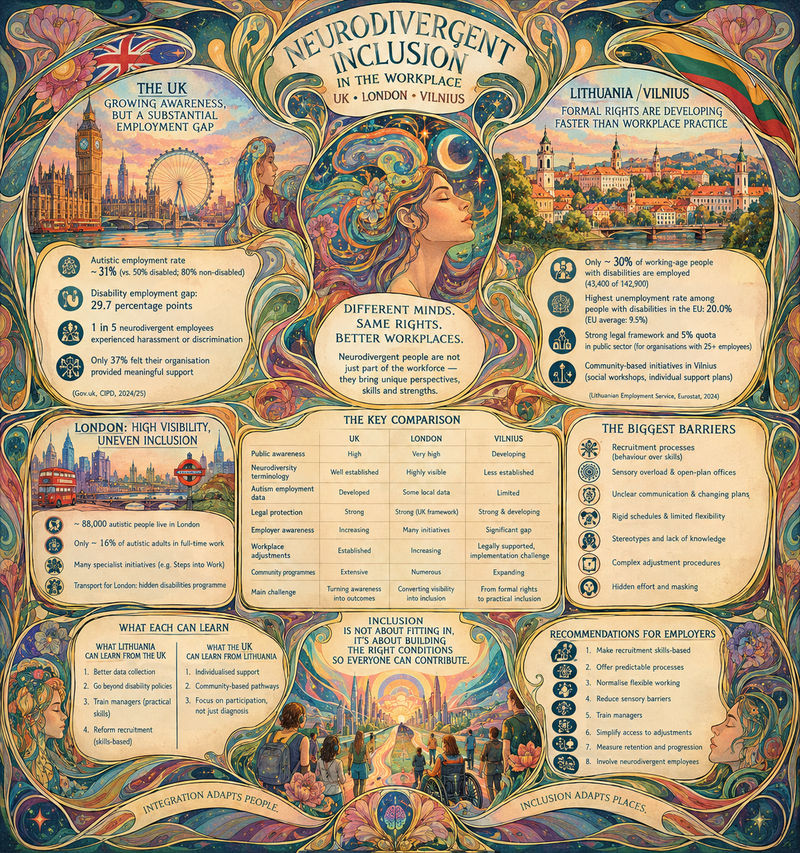
Neurodivergent Inclusion in the Workplace: A Comparison of the UK, London and Vilnius, Lithuania
Introduction
Neurodiversity has become an increasingly important issue in discussions about equality, employment and the future of work. The term *neurodivergent* generally refers to people whose neurological development or functioning differs from dominant societal expectations, including autistic people and people with ADHD, dyslexia, dyspraxia and other conditions. Yet recognising neurodiversity is not the same as creating genuinely inclusive workplaces. A person may technically have access to employment while still facing barriers during recruitment, difficulties with communication and workplace culture, inadequate reasonable adjustments, discrimination or limited opportunities for career progression. This article compares the workplace inclusion of neurodivergent people in the United Kingdom, London and Vilnius/Lithuania.
The comparison shows an interesting contrast: the UK has a more developed public conversation and institutional infrastructure around neuroinclusion, while Lithuania has been developing its disability-employment framework and community-based support more recently. At the same time, neither system has yet closed the substantial gap between formal equality and everyday workplace inclusion. ---
1. The UK: growing awareness, but a substantial employment gap The UK has made considerable progress in recognising neurodiversity as a workplace issue. Government, employers and professional organisations increasingly discuss neuroinclusion alongside equality, diversity and inclusion (EDI). However, the employment figures demonstrate how far there is still to go.
The Buckland Review of Autism Employment, published by the UK Department for Work and Pensions in 2024, found that only around three in ten working-age autistic people were in employment, compared with around five in ten disabled people overall and eight in ten non-disabled people. The review also noted that autistic people experience one of the largest disability-related pay gaps. ([GOV.UK][1]) More recent UK government statistics reinforce the scale of the problem. In 2024/25, the employment rate for disabled people aged 16–64 was 52.8%, compared with a disability employment gap of 29.7 percentage points.
For people whose main health condition was autism, the employment rate was only 31.4%. ([GOV.UK][2]) This is important because it challenges the idea that the main problem is simply a lack of qualifications or skills. Many neurodivergent people possess valuable skills, but recruitment systems and workplace cultures may not be designed to recognise or accommodate different ways of communicating, processing information or working.
Workplace experience
The problem does not end once someone gets a job. Research by the Chartered Institute of Personnel and Development (CIPD) found that one in five neurodivergent employees surveyed had experienced harassment or discrimination at work because of their neurodivergence.
Only about half felt that their organisation had an open and supportive climate in which neurodiversity could be discussed. ([CIPD][3]) More recent CIPD analysis also reports that only 37% of neurodivergent employees felt their organisation provided meaningful support.
The process of obtaining workplace adjustments can itself become a barrier: employees may have to complete complicated procedures, repeatedly explain their needs or wait for decisions. ([CIPD][4]) This produces what can be called an “accommodation paradox”: an organisation may formally offer reasonable adjustments while designing the process for obtaining them in a way that is itself inaccessible. ---
2. London: greater visibility, but inclusion remains uneven London presents a particularly interesting case because it combines a large and diverse labour market with substantial institutional and community activity around disability and neurodiversity. The Greater London Authority has recognised the scale of the issue. A London Assembly publication estimated that approximately 88,000 autistic people live in London and highlighted research suggesting that only around 16% of autistic adults were in full-time paid work.
The Assembly has also recognised the wider barriers faced by neurodivergent Londoners. ([London City Hall][5]) The figures should be interpreted carefully because they come from different periods and methodologies than the newer UK statistics. Nevertheless, they demonstrate that London has not escaped the national employment problem. London's wider disability employment gap is also significant. The London Assembly has reported that working-age disabled Londoners were substantially less likely to be in employment than non-disabled Londoners.
At the same time, London has performed relatively well compared with several other UK regions in reducing the disability employment gap. ([London City Hall][6]) London has an important advantage: institutional visibility One of London's strengths is the number of organisations and initiatives specifically addressing neurodivergent employment. For example, the Greater London Authority has highlighted initiatives such as Steps into Work, a programme involving Barnet & Southgate College, Transport for London and Mencap that provides placements and employment preparation for people with learning difficulties and autistic people. ([London City Hall][7]) London's public institutions have also addressed hidden disabilities and accessibility. Transport for London, for example, has developed initiatives aimed at making the transport system more accessible to people with non-visible disabilities. ([London City Hall][8])
This illustrates an important characteristic of London: neurodiversity has become visible within public policy and employer conversations, even though actual employment outcomes remain unequal. ---
3. Lithuania: formal rights are developing faster than workplace practice Lithuania has a different starting point. The country has established a legal framework protecting the employment rights of people with disabilities. Lithuanian legislation recognises the right of people with disabilities to employment and vocational rehabilitation and provides for measures supporting employers who employ people with disabilities. The legal framework also requires appropriate adaptation of working conditions where necessary.
An important recent development is the requirement that certain state and municipal organisations with at least 25 employees have a workforce in which people with disabilities account for at least 5% of employees, subject to the statutory conditions. However, the existence of legal rights does not automatically translate into equal participation in the labour market. The Lithuanian Employment Service reported in 2024 that there were 142,900 working-age people with disabilities in Lithuania, of whom only 43,400 were employed. The organisation identified persistent employer stereotypes and insufficient knowledge about disability as significant barriers. ([Užimtumo tarnyba][9]) That means only roughly 30% of this working-age disabled population was employed according to those figures. Eurostat data provides another indication of the challenge.
In 2024, Lithuania had the highest unemployment rate among people with disabilities aged 15–64 in the EU, at 20.0%, compared with an EU average of 9.5%. The unemployment-rate gap between people with and without disabilities was also particularly large in Lithuania. ([European Commission][10]) These figures do not measure neurodivergence specifically. Nevertheless, they provide important context because autism, ADHD and other neurodevelopmental differences can fall within disability frameworks when they substantially affect a person's functioning. ---
4. Vilnius: promising community-based approaches Vilnius provides evidence of a shift away from viewing disability primarily through a welfare perspective towards a model based more strongly on participation, employment and individual capability**. In 2024, Vilnius City Municipality announced funding for social workshops designed to develop independence and employment-related skills among people with disabilities and prepare participants for the open labour market. ([Vilniaus miesto savivaldybė][11]) Particularly relevant to neurodiversity is the municipality's support for social workshops organised by Lietaus vaikai, an organisation working with autistic people.
The initiative recognises that autistic adults have different levels of support needs: some can compete in the open labour market, while others may require ongoing assistance. ([Vilniaus miesto savivaldybė][12]) This is significant because it introduces an important principle: Inclusion does not necessarily mean expecting every employee to work in exactly the same way. Instead, meaningful inclusion means creating different routes into participation according to individual abilities, support requirements and aspirations. Vilnius is also developing broader community-based services intended to increase the employment prospects of people with intellectual or psychosocial disabilities. The city's social-workshop programme uses individual plans based on each participant's abilities and potential. ([Vilniaus miesto savivaldybė][13]) ---
5. The key comparison Although the data cannot support a perfectly like-for-like statistical comparison, several differences emerge. | Dimension | UK | London | Lithuania / Vilnius | | ------------------------------- | -------------------------------------- | ----------------------------------------------- | --------------------------------------------------------- | | Public awareness | Relatively high and rapidly developing | Particularly high | Developing | | Neurodiversity terminology | Well established | Highly visible | Less established institutionally | | Autism employment data | Relatively developed | Some London-specific evidence | Limited | | Legal disability protection | Strong | Same UK framework | Strong and developing | | Employer awareness | Increasing but inconsistent | Many specialist initiatives | Significant gap remains | | Workplace adjustments | Established concept | Increasingly promoted | Legally supported, but implementation remains a challenge | | Community employment programmes | Extensive | Numerous programmes | Expanding | | Main challenge | Turning awareness into outcomes | Converting visibility into widespread inclusion | Moving from formal rights to practical inclusion | The comparison suggests that the UK and London are somewhat further along in recognising neurodiversity as a distinct workplace issue, whereas Lithuania is still more likely to approach the issue through the broader framework of disability inclusion. This distinction matters.
A person with autism, ADHD or dyslexia may not necessarily identify as disabled. Consequently, a workplace can have a disability policy while still failing to address neurodivergent employees' actual experiences. ---
6. Recruitment is one of the biggest barriers Across both countries, recruitment deserves particular attention. Traditional recruitment tends to reward a relatively narrow set of behaviours: maintaining eye contact; performing well in unstructured interviews; responding immediately to questions; demonstrating confidence through conventional social interaction; tolerating noisy or unfamiliar environments; interpreting ambiguous instructions; networking and informal relationship-building.
None of these characteristics necessarily predicts whether someone will perform well in a particular job. For an autistic person, an interview may measure social performance rather than analytical ability. For someone with ADHD, a recruitment process involving lengthy forms and multiple administrative steps may create unnecessary barriers. For a dyslexic candidate, written tests may disproportionately measure reading speed rather than job competence. The UK has increasingly recognised this problem. The Buckland Review specifically identified recruitment and employer behaviour as areas requiring change. ([GOV.UK][1])
Lithuania faces a similar challenge, although the problem is often framed more broadly as employer stigma towards people with disabilities. The Lithuanian Employment Service explicitly identified stereotypes, fear and lack of knowledge among barriers to employment. ([Užimtumo tarnyba][14]) ---
7. The workplace itself can become the barrier getting hired is only the first stage of inclusion. Neurodivergent employees can encounter difficulties with: * open-plan offices and sensory overload; * unpredictable schedules; * excessive meetings; * unclear priorities; * ambiguous communication; * workplace politics; * sudden changes; * rigid working hours; * noisy social environments; * performance management based on subjective impressions; * lack of quiet spaces; * limited flexibility.
These barriers are often not visible to colleagues or managers. For example, an employee may appear to be coping successfully while spending considerable energy masking their neurodivergent characteristics.
Over time, this can contribute to exhaustion, stress and disengagement. The CIPD's research illustrates the gap between organisational policy and employee experience. Although neuroinclusion is increasingly discussed by employers, many neurodivergent workers still do not feel adequately supported. ([CIPD][15]) ---
8. What Lithuania could learn from the UK — and what the UK could learn from Lithuania The comparison should not be interpreted as a simple hierarchy in which the UK is “inclusive” and Lithuania is “behind”. Each has different strengths.
What Lithuania could learn from the UK The UK experience demonstrates the value of:
1. Collecting better data
It is difficult to improve what is not measured. UK institutions have increasingly developed specific data on autism and employment. Lithuania would benefit from greater visibility of neurodivergent people within labour-market statistics, while respecting privacy and avoiding forced disclosure.
2. Moving beyond disability policies
Organisations should explicitly address neurodiversity rather than assuming that a general disability policy is sufficient.
3. Training managers
A neurodivergent employee's experience can depend heavily on their immediate manager. Training should focus on practical management rather than stereotypes.
4. Reforming recruitment
Skills-based recruitment, structured interviews, work trials and alternative assessment methods can reduce unnecessary barriers. --- ### What the UK could learn from Lithuania Lithuania's emerging model also offers useful lessons.
1. Individualised support
Vilnius's social workshops emphasise individual plans based on people's abilities and needs. ([Vilniaus miesto savivaldybė][13]) This reflects an important principle: there is no single “neurodivergent employee”.
2. Community-based employment pathways
Employment support does not have to begin with a conventional job application. Social enterprises, workshops, supported employment and transitional programmes can create routes into the labour market.
3. Focus on participation rather than diagnosis
A particularly valuable idea emerging from Vilnius initiatives is that people should be given opportunities to contribute according to what they can do, rather than being defined primarily by their diagnosis. ([Vilniaus miesto savivaldybė][12]) ---
9. From integration to genuine inclusion The word “integration” is useful but potentially misleading. Integration can mean that a neurodivergent person is expected to enter an existing workplace and adapt themselves to it.
Inclusion is different.
An inclusive workplace asks whether the workplace itself needs to change. This distinction can be represented as: Integration: “We have hired you. Now adapt to the way we work.”
Inclusion:
“We want you to succeed. How can we design the way we work so that different people can contribute effectively?” This does not mean lowering professional standards. Rather, it means separating essential job requirements from traditional ways of demonstrating competence.
A neurodivergent employee should still be expected to meet legitimate performance requirements. But they should not be required to perform unnecessary social or sensory behaviours simply because those behaviours are culturally familiar to non-neurodivergent colleagues. ---
10. Recommendations for employers in the UK, London and Vilnius
The evidence from both countries suggests that effective neuroinclusion requires several interconnected measures.
1. Make recruitment skills-based Employers should identify the actual skills required for a position and avoid unnecessary assessment of social behaviours.
2. Offer predictable recruitment processes Provide interview questions or themes in advance, explain the stages of recruitment clearly and allow reasonable adjustments. 3. N
ormalise flexible working Flexibility can include remote work, hybrid work, flexible hours, predictable schedules or additional breaks.
4. Reduce sensory barriers Quiet spaces, headphones, lighting adjustments and alternatives to open-plan environments can benefit many employees, not only neurodivergent ones.
5. Train managers Managers need practical knowledge about communication, reasonable adjustments, performance management and different working styles.
6. Simplify access to adjustments An adjustment should not require an employee to repeatedly justify or medically prove their needs when the organisation already has sufficient information to provide support. 7. Measure retention and progression Employers should not measure inclusion solely by how many neurodivergent people they recruit. They should also examine: * retention; * promotion; * pay; * employee wellbeing; * access to training; * job satisfaction; * disciplinary processes; * leadership representation.
8. Involve neurodivergent employees Policies should be designed **with** neurodivergent employees rather than merely **for** them. ---
Conclusion
The comparison between the UK, London and Vilnius reveals a common contradiction. Awareness of neurodiversity is increasing faster than genuine workplace inclusion.** The UK has developed comparatively sophisticated research, policy discussions and employer guidance. Yet autistic employment remains dramatically lower than employment among non-disabled people, and many neurodivergent employees continue to experience discrimination or inadequate workplace support. ([GOV.UK][1])
London benefits from a particularly visible ecosystem of public-sector programmes, employers and community organisations working on disability and neurodiversity. Nevertheless, the city continues to experience substantial employment inequalities. ([London City Hall][16]) Lithuania and Vilnius are at a different stage. The legal framework increasingly recognises equal employment rights and reasonable accommodation, while municipal and employment-service initiatives are creating more community-based routes into employment.
Yet employer stereotypes and the comparatively high unemployment of disabled people demonstrate that significant barriers remain. ([Užimtumo tarnyba][9]) Ultimately, the most important shift is conceptual. Neurodivergent people should not be viewed primarily as people who need to be **“fixed” or integrated into the workplace**.
They should be recognised as part of the workforce whose different cognitive styles, strengths and support needs can be accommodated through better-designed organisations. The UK demonstrates the value of **visibility, research and institutional advocacy**.
Vilnius demonstrates the value of **individualised and community-based pathways into participation**. The most effective future model would combine both: robust legal protection and data, employer accountability, flexible workplace design, individual support and—above all—the meaningful participation of neurodivergent people in decisions about the workplaces in which they are expected to succeed.
*Note on evidence:
A direct UK–Lithuania comparison of “neurodivergent employment” is currently limited because national statistical systems do not define or measure neurodivergence in the same way. The strongest quantitative indicators therefore use autism-specific data and broader disability-employment statistics. These should not be interpreted as representing every neurodivergent person.
References:
([GOV.UK][17]) [1]: https://www.gov.uk/government/publications/the-buckland-review-of-autism-employment-report-and-recommendations/the-buckland-review-of-autism-employment-report-and-recommendations?campaignkw=Buckland+Review+Recommendations&utm_source=chatgpt.com "The Buckland Review of Autism Employment: report and recommendations - GOV.UK" [2]: https://www.gov.uk/government/statistics/the-employment-of-disabled-people-2025/the-employment-of-disabled-people-2025?utm_source=chatgpt.com "The employment of disabled people 2025 - GOV.UK" [3]: https://www.cipd.org/uk/about/press-releases/one-in-five-neurodivergent-employees-experienced-harassment-or-discrimination-at-work/?utm_source=chatgpt.com "One in five neurodivergent employees have experienced harassment or discrimination at work because of their neurodivergence | CIPD" [4]: https://www.cipd.org/uk/about/blogs/what-neurodivergent-workers-are-telling-us-what-managers-need-to-understand/?utm_source=chatgpt.com "What neurodivergent workers are telling us – and what managers need to understand | CIPD" [5]: https://www.london.gov.uk/press-releases/assembly/assembly-calls-for-london-wide-autism-strategy?utm_source=chatgpt.com "Assembly calls for London-wide autism strategy" [6]: https://www.london.gov.uk/who-we-are/what-london-assembly-does/london-assembly-publications/tackling-londons-disability-employment-gap?utm_source=chatgpt.com "Tackling London's disability employment gap" [7]: https://www.london.gov.uk/city-hall-blog/steps-work-gla?utm_source=chatgpt.com "Steps into work at the GLA | London City Hall" [8]: https://www.london.gov.uk/who-we-are/what-london-assembly-does/questions-mayor/find-an-answer/hidden-disabilities-tfl-network-1?utm_source=chatgpt.com "Hidden disabilities on the TfL network (1)" [9]: https://uzt.lt/naujienos/8/galimybes-ir-issukiai-kintancioje-darbo-rinkoje-itrauki-ateitis-visiems%3A409?utm_source=chatgpt.com "Galimybės ir iššūkiai kintančioje darbo rinkoje – įtrauki ateitis visiems | Užimtumo tarnyba" [10]: https://ec.europa.eu/eurostat/statistics-explained/SEPDF/cache/140941.pdf?v=4766361609280709&utm_source=chatgpt.com "Unemployment rate of people aged 15–64 years, by level of disability, EU, 2024" [11]: https://vilnius.lt/naujienos/vilniaus-miesto-savivaldybe-plecia-paslaugas-asmenims-su-negalia-finansuos-socialines-dirbtuves?utm_source=chatgpt.com "Vilniaus miesto savivaldybė plečia paslaugas asmenims su negalia – finansuos socialines dirbtuves - Vilniaus miesto savivaldybė" [12]: https://vilnius.lt/naujienos/igalinti-autistiskus-asmenis-dirbti-lietaus-vaiku-socialines-dirbtuves?utm_source=chatgpt.com "Įgalinti autistiškus asmenis dirbti: Lietaus vaikų socialinės dirbtuvės - Vilniaus miesto savivaldybė" [13]: https://vilnius.lt/projektai/perejimas-nuo-institucines-globos-prie-bendruomeniniu-paslaugu-sostines-regione-vidurio-ir-vakaru-lietuvos-regione?utm_source=chatgpt.com "Perėjimas nuo institucinės globos prie bendruomeninių paslaugų Sostinės regione Vidurio ir vakarų Lietuvos regione - Vilniaus miesto savivaldybė" [14]: https://uzt.lt/naujienos/8/vilniuje-darbdaviai-mokesi-sekmingo-zmoniu-su-psichosocialine-negalia-idarbinimo-paslapciu%3A336?utm_source=chatgpt.com "Vilniuje darbdaviai mokėsi sėkmingo žmonių su psichosocialine negalia įdarbinimo paslapčių | Užimtumo tarnyba" [15]: https://www.cipd.org/uk/knowledge/reports/neuroinclusion-at-work/?utm_source=chatgpt.com "Neuroinclusion at work report 2024 | CIPD" [16]: https://www.london.gov.uk/who-we-are/what-london-assembly-does/questions-mayor/find-an-answer/neurodiversity-london?utm_source=chatgpt.com "Neurodiversity in London - Greater London Authority" [17]: https://www.gov.uk/government/statistics/the-employment-of-disabled-people-2024/the-employment-of-disabled-people-2024?utm_source=chatgpt.com "The employment of disabled people 2024 - GOV.UK"

Visas autorines teises saugo įstatymas. Dėl tekstų publikavimo prašome kreiptis į redakciją. Redakcija adreso ir savininkų neturi. Tekstus ar jų dalis publikuoti neatsiklausus redakcijos draudžiama, tai padaryti galima tik gavus redakcijos leidimą. Radikaliai.lt redakcija tekstų negrąžina, nenaikina, neredaguoja. Honoraras autoriams nemokamas. Radikaliai.lt leidžiamas nemokamai. Visos fotografijos publikuojamos gavus jų savininkų leidimus. Jei po fotografija neparašyta, kas jos savininkas, vadinasi, jis yra kalbinama grupė ar muzikantas (ir pan.). Visos pretenzijos dėl nuotraukų autorystės bus sprendžiamos tik taikiu keliu.
© radikaliai.lt 2011–2025 | Kontaktai