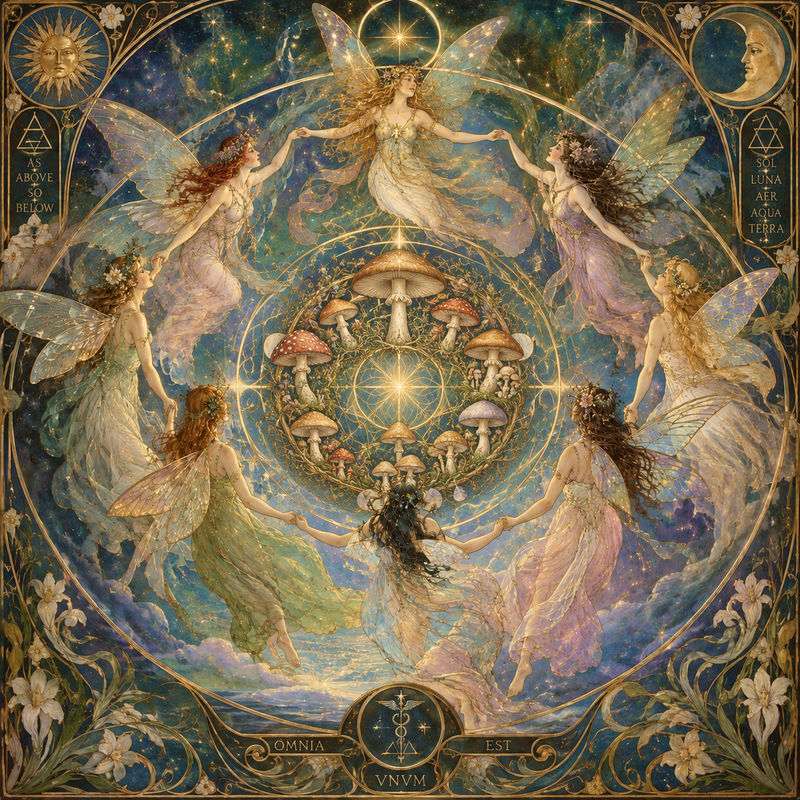
Circles of fairies
Onutė Gaidamavičiūtė
2026 m. Rugsėjo 14 d., 18:25
Skaityta: 0 k.
Below is a research-style anthropological essay that treats “fairy rings” and “fairy circles” as both ecological phenomena and cultural interpretations of landscape. An important distinction is that the European fairy ring
Fairy Rings and Fairy Circles: An Anthropological Study of Landscape, Supernatural Agency, and Cultural Meaning Abstract
Circular formations in landscapes have attracted human attention for centuries. Among the most culturally significant are the phenomena commonly called **“fairy rings,” “fairy circles,” “witches’ rings,”** and related terms. In Europe, fairy rings generally refer to circular arrangements of mushrooms or conspicuously altered vegetation. These formations became associated with fairies, witches, elves, demons, dragons, and other supernatural beings. In southern Africa, meanwhile, the term *fairy circle* has been applied to a strikingly different phenomenon: large, regularly spaced barren patches occurring in arid grasslands, especially along the eastern margins of the Namib Desert. Similar phenomena have also been documented in Australia.
This paper examines fairy rings and circles anthropologically rather than treating them simply as botanical curiosities. It argues that circular landscape formations provide a particularly revealing example of how human societies interpret **anomalies, boundaries, agency, danger, fertility, and the relationship between visible and invisible worlds**. European traditions frequently conceptualized rings as places where supernatural beings danced, celebrated, or lived. In Namibia and Australia, Indigenous knowledge demonstrates that local interpretations cannot simply be assumed to correspond to European notions of “fairies.” Indeed, recent scholarship has criticized the scientific literature for paying insufficient attention to Indigenous understandings of these landscapes. ([Nature][1])
The study therefore distinguishes the **material phenomenon** from the **cultural category**. A ring in the landscape is not inherently a “fairy ring”; rather, *fairy ring* is a cultural interpretation imposed upon a particular visual pattern. Across societies, however, the recurring tendency to associate unusual circular spaces with supernatural agency reveals important common features of human environmental perception.
**Keywords:** fairy rings, fairy circles, anthropology, folklore, landscape, supernatural, fungi, Namibia, Indigenous knowledge, ritual, liminality
---
# 1. Introduction: Why Do People See “Fairy Rings”?
Imagine walking through a meadow and suddenly encountering a nearly perfect circle of mushrooms. The surrounding vegetation appears ordinary, but within this unusual formation the grass may be darker, greener, shorter, or otherwise different. There is no obvious human explanation for its geometry.
For a modern ecologist, the first questions might concern fungal mycelium, soil chemistry, nutrient distribution, water availability, or plant–fungus interactions. Indeed, contemporary research understands many European fairy rings as manifestations of fungal growth, particularly the radial expansion of fungal mycelia through soil. ([PubMed Central (PMC)][2])
For earlier communities, however, the relevant question was not necessarily *“What biological process produced this?”* but rather:
> **“Who made this?”**
That question is anthropologically important.
When people encounter an unusual feature in their environment, they often interpret it through concepts of **agency**. If something appears organized, intentional, or inexplicable, it can be understood as the work of an agent—human, animal, divine, magical, ancestral, or otherwise supernatural.
The circular form is especially powerful because circles are among the most recognizable geometric patterns in nature. They have no obvious beginning or end and can therefore become associated with ideas of **wholeness, enclosure, repetition, protection, ritual space, and boundaries**.
The anthropology of fairy rings is consequently not simply an anthropology of “superstition.” It is an investigation of how human beings transform ecological observations into culturally meaningful landscapes.
---
# 2. A Necessary Distinction: Fairy Rings and Namibian Fairy Circles
One of the most important points in studying the subject is that **“fairy ring” and “fairy circle” do not necessarily describe the same natural phenomenon**.
### European fairy rings
The classic European fairy ring consists of a circular or arc-shaped arrangement of mushrooms, often accompanied by visible changes in the surrounding vegetation. Fungal fairy rings are produced by the outward expansion of fungal mycelium and may generate distinctive patterns of vegetation. The scientific term has survived despite its supernatural origins. ([PubMed Central (PMC)][2])
### Namibian fairy circles
Namibian fairy circles are fundamentally different. They are generally **bare, circular patches of ground within arid grasslands**, commonly around 2–12 metres in diameter and often surrounded by taller grass. They occur particularly in sandy regions along the eastern edge of the Namib Desert, extending through parts of Angola, Namibia, and South Africa. ([PubMed Central (PMC)][3])
Scientific explanations remain debated. Proposed mechanisms have included termite activity, vegetation self-organization and competition for water, chemical effects, soil processes, and other mechanisms. Experimental and review literature has not produced universal agreement about a single explanation. ([ScienceDirect][4])
This distinction is anthropologically significant because **the same cultural label can be applied to biologically different phenomena**.
The word *fairy* therefore tells us more about human interpretation than it does about the ecology of the formation.
---
# 3. Europe: The Fairy Ring as a Supernatural Dance Floor
European traditions provide some of the richest examples.
Across Britain and Ireland, circular mushroom formations became associated with **fairies, elves, witches, and supernatural dancing**. Welsh traditions, for example, associated fairy rings with the *Tylwyth Teg*, literally the “fair folk.” ([Wikipedia][5])
The basic narrative structure is remarkably persistent:
1. Supernatural beings gather at night.
2. They dance, feast, sing, or celebrate.
3. Their activity produces or reveals a circle.
4. Humans who enter the circle risk supernatural consequences.
The ring thus becomes a **trace of an invisible event**.
This is an important anthropological concept. The mushrooms are not necessarily understood as the supernatural beings themselves. Instead, they function as **material evidence of an invisible community**.
The landscape becomes something resembling an archaeological site: a visible remnant of something that supposedly occurred when humans were absent.
---
# 4. The Fairy Ring as a Liminal Space
Anthropologically, fairy rings can be understood through the concept of **liminality**.
A liminal space is neither fully one thing nor another. It exists at a boundary.
A fairy ring in a meadow is physically part of the meadow, but culturally it can be imagined as a threshold between:
* human and supernatural worlds,
* ordinary and extraordinary time,
* safety and danger,
* civilization and wilderness,
* visible and invisible reality,
* life and death.
This helps explain why fairy rings were often treated with caution.
The important question was not simply:
> “What is inside the circle?”
but:
> **“What happens when a human being crosses its boundary?”**
The circle therefore becomes a cultural technology for marking **forbidden or exceptional space**.
---
# 5. Entering the Circle: Danger and Time
Many European traditions warned against entering fairy rings.
The danger could take several forms. A person might:
* become enchanted,
* become invisible,
* disappear,
* be transported into the fairy realm,
* lose track of time,
* become sick,
* or be forced to dance.
One particularly important motif is **distorted time**.
A person may believe that only a short period has passed while, in the human world, years or decades have elapsed.
From an anthropological perspective, this is more than a supernatural story. It expresses the idea that crossing a boundary between worlds can mean leaving ordinary social time.
The fairy ring therefore represents a kind of **temporal threshold**.
---
# 6. Ireland and the Gaelic Imagination
In Irish folklore, fairies were not simply tiny winged creatures of children's literature. The *fair folk* belonged to a much more complicated supernatural landscape.
Fairies could be associated with:
* hills,
* ancient monuments,
* trees,
* springs,
* caves,
* crossroads,
* particular fields,
* and other unusual landscape features.
The fairy ring therefore belongs to a broader **sacred geography**.
Particularly significant was the relationship between fairy beings and **hawthorn trees**. Some Irish traditions associated fairy gatherings with hawthorns, and rings could occur around such trees. ([Wikipedia][5])
This demonstrates an important principle in folklore:
> **Supernatural geography is often highly specific.**
The landscape is not uniformly enchanted. Particular trees, stones, hills, rings, wells, or fields acquire identities through storytelling.
---
# 7. Wales: The Tylwyth Teg and the Circle
Welsh folklore provides another particularly rich example.
Fairy rings were known as **cylch y Tylwyth Teg**, associated with the *Tylwyth Teg*, the Welsh “Fair Folk.” Folklore recorded in Wales connected these circles with supernatural dancing. ([Wikipedia][5])
The dance is anthropologically significant.
Dancing in a circle is itself a social and ritual activity found throughout human societies. A circular dance creates:
* a collective boundary,
* coordinated movement,
* repetition,
* separation from ordinary behavior,
* and a temporary community.
The supernatural dance therefore mirrors a recognizable human social practice.
The fairy ring can consequently be understood as an imagined **non-human social space**.
Humans dance in circles; therefore, supernatural communities may also dance in circles.
---
# 8. Scotland: The Fairy Ring as Evidence of an Invisible Community
Scottish folklore similarly associates fairy rings with supernatural activity.
Accounts describe fairies dancing, sitting upon mushrooms, eating, or using mushrooms as furniture or shelter. ([Wikipedia][5])
Here the mushroom is transformed through imagination.
A mushroom that appears biologically insignificant becomes:
* a chair,
* a table,
* an umbrella,
* a parasol,
* or another piece of fairy architecture.
This is an excellent example of **anthropomorphic environmental interpretation**.
Humans understand unfamiliar environments partly by projecting familiar social structures onto them.
If humans require houses, tables, chairs, food, and dances, supernatural beings may be imagined as having analogous institutions.
---
# 9. France, Italy, and Spain: From Fairies to Witches
The supernatural interpretation of fungal rings was not limited to Celtic cultures.
Different European languages preserve terminology linking circular fungal formations with supernatural agents.
Examples include:
* Italian **cerchio delle streghe** — “witches' circle,”
* French **rond de sorcière** — “witches' ring,”
* Spanish **corro de brujas** — “circle of witches.” ([PubMed Central (PMC)][2])
This linguistic variation is revealing.
The biological phenomenon remains broadly similar, but the **supernatural agent changes**.
In one cultural context:
> fairies dance here.
In another:
> witches gather here.
The underlying cognitive pattern is nevertheless similar:
> **An unusual circular natural pattern is evidence of intentional supernatural activity.**
This suggests that cultural interpretations are shaped by locally available supernatural categories.
---
# 10. The Christianization of the Fairy Ring
European folklore also reveals a historical transition from pagan or folkloric supernaturalism toward Christian demonology.
The supernatural beings associated with rings could shift from:
**fairies → witches → demons → the Devil**
The landscape remained strange, but the explanation changed according to the religious worldview.
This process demonstrates that supernatural interpretation is **historically dynamic**.
A mushroom ring did not possess a single eternal meaning. Its interpretation depended upon the dominant cosmology of the community observing it.
---
# 11. Japan: The “White Castle”
The phenomenon has also been incorporated into Japanese folklore.
Mushroom fairy rings are sometimes associated with the term **shiro**, meaning “white” and “castle,” reflecting the idea of an underground palace associated with the mushrooms. ([National Geographic][6])
This is fascinating because it demonstrates that the same visual phenomenon does not automatically produce the same mythology.
European traditions frequently emphasize:
> **dance**
while the Japanese tradition described in contemporary folklore discussions emphasizes:
> **architecture / an underground supernatural dwelling**
The underlying mushroom ring becomes a clue to an invisible world beneath the surface.
Again, the visible landscape functions as a **portal or trace** of an unseen realm.
---
# 12. Namibia: A Different Kind of “Fairy Circle”
The Namibian case requires particular caution.
Namibian fairy circles are not mushroom rings. They are large, bare circular patches in grasslands, often regularly spaced across enormous areas.
They are visually extraordinary.
Satellite imagery makes them particularly striking because thousands of circles can form extensive spatial patterns. Scientific research has shown that the circles appear, develop, and eventually become revegetated; one study estimated characteristic lifespans on the order of decades. ([PLOS][7])
Yet the term **“fairy circle” itself is largely a scientific and popular label**, and anthropologists should avoid assuming that Indigenous Namibian communities conceptualize these formations as European-style “fairy rings.”
This is one of the most important methodological lessons of the subject.
---
# 13. Himba Interpretations and the Dragon Motif
Some published accounts report a traditional Himba explanation in which a dragon beneath the earth breathes fire or releases fiery bubbles, producing the circular barren areas.
One scientific article explicitly records a Himba tradition describing a crack in the earth containing a dragon whose fiery exhalations create the circles. ([ScienceDirect][8])
This interpretation is particularly interesting because it provides a striking parallel with European supernatural explanations while remaining culturally distinct.
The basic structure is:
**unusual landscape → invisible agent → visible environmental consequence**
But the supernatural agent is not a European fairy.
It is a **dragon associated with subterranean forces**.
This demonstrates why anthropologists must distinguish between **structural similarities** and **historical borrowing**.
Two cultures can independently interpret mysterious landscape phenomena through supernatural agency without sharing the same mythology.
---
# 14. Indigenous Knowledge and the Problem of Scientific Naming
Recent research has raised an important criticism concerning Namibian fairy circles.
Scientific literature has often concentrated on explaining the physical mechanism while giving comparatively little attention to the historical and contemporary knowledge of San, Khoi/Khoekhoe-speaking, and Bantu-speaking communities living within or near these landscapes. ([Nature][1])
This creates an anthropological problem.
When scientists call something a **“fairy circle,”** they may unintentionally impose an external category on an Indigenous landscape.
The name makes the phenomenon sound like the European fairy-ring tradition even when the local cultural meanings may be entirely different.
This is a broader issue in anthropology:
> **Who has the authority to name a landscape?**
Naming is not neutral.
To call a place a “fairy circle,” “termite mound,” “sacred site,” “wilderness,” or “desert anomaly” places it inside a particular conceptual system.
---
# 15. Australia: First Peoples' Knowledge and Linyji
The Australian case is particularly important because research has identified comparable circular vegetation patterns and connections with Indigenous knowledge.
A 2023 study examined Aboriginal knowledge concerning **linyji**, linking landscape patterns with termite activity and Indigenous representations. The authors explicitly argued that scientific research had historically paid insufficient attention to Indigenous knowledge surrounding these phenomena. ([Nature][1])
This provides an important counterpoint to the European tradition.
Rather than assuming:
> “People saw mysterious circles and invented fairies,”
anthropology can ask:
> **“What ecological knowledge does the local community possess about these patterns?”**
Indigenous ecological knowledge may encode relationships between:
* termites,
* vegetation,
* soil,
* water,
* animals,
* seasonal changes,
* fire,
* and human movement.
Consequently, a landscape pattern that appears mysterious to an outside observer may be **ecologically intelligible within local knowledge systems**.
---
# 16. Fairy Rings as Ecological Knowledge
This leads to a deeper anthropological interpretation.
Folklore is sometimes dismissed as the opposite of scientific knowledge. But that distinction can be too simplistic.
A story about supernatural beings may simultaneously function as a **behavioral rule**.
For example:
> “Do not enter the circle.”
may protect people from:
* dangerous terrain,
* poisonous organisms,
* unstable ground,
* nocturnal hazards,
* socially restricted places,
* or simply places that a community has learned to avoid.
Similarly, a supernatural explanation can preserve an observation across generations.
The story may change while the environmental observation remains remarkably stable.
---
# 17. The Ring as a Boundary
One of the strongest cross-cultural themes is the concept of **boundary**.
A circle naturally separates:
**inside ↔ outside**
This makes circular landscape formations especially suitable for symbolic interpretation.
The inside can represent:
* sacred space,
* supernatural space,
* danger,
* fertility,
* death,
* community,
* secrecy,
* or transformation.
The outside represents ordinary human space.
Thus the fairy ring becomes a **cartographic symbol of otherness**.
---
# 18. Fertility and the Paradox of the Ring
Fairy rings also produce an intriguing ecological paradox.
Fungal fairy rings can produce areas where vegetation becomes noticeably greener or more vigorous, although some rings can also produce dead or sparse vegetation depending on fungal species and ecological conditions. ([PubMed Central (PMC)][2])
This creates an association between the ring and **fertility**.
A strange circle appears in otherwise ordinary grassland and suddenly the vegetation becomes unusually lush.
Such a phenomenon is highly compatible with fertility mythology.
The supernatural explanation might therefore be:
> supernatural beings have danced here,
but underneath the story lies an observable ecological fact:
> something unusual is happening to the vegetation.
The mythology transforms ecological difference into cultural meaning.
---
# 19. The Circle as a Trace
Perhaps the most useful anthropological concept for understanding fairy rings is that of the **trace**.
The supernatural beings themselves are invisible.
What remains visible is their supposed activity.
This pattern appears widely in mythology.
Humans often explain unusual physical traces through invisible agents:
* footprints → giants,
* strange stones → supernatural beings,
* unusual lights → spirits,
* unexplained noises → ghosts,
* circular vegetation → fairies or witches.
The fairy ring is therefore a classic example of **material evidence for an invisible ontology**.
The landscape becomes a document.
---
# 20. Anthropomorphism and Agency
Why attribute circles to fairies, witches, dragons, or other beings?
One possible explanation involves what cognitive anthropologists call **agency detection**.
Humans are highly sensitive to patterns that suggest intentional action. If a natural formation appears organized, regular, or purposeful, people may search for an agent responsible for it.
A nearly perfect circle is particularly suggestive of intentional design because humans themselves produce circles deliberately.
Thus:
> **“Someone made this”**
may be psychologically more intuitive than:
> **“This emerged through a complex ecological process.”**
The supernatural being becomes an explanatory agent.
---
# 21. Why Fairies?
There is also a cultural reason why fairies became associated with these spaces in parts of Europe.
Fairies occupied a peculiar position in European folklore.
They were neither simply gods nor simply animals. They were often represented as beings inhabiting a parallel society close to—but separate from—the human world.
This made them ideal inhabitants of ambiguous spaces.
A fairy ring is:
* natural but unnatural,
* visible but mysterious,
* familiar but strange,
* accessible but dangerous.
The fairy occupies precisely the same conceptual position.
---
# 22. The Fairy Ring and Social Order
Fairy-ring stories can also be interpreted as **social regulation**.
A community can use stories to communicate behavioral rules without formal legislation.
For example:
> Do not disturb the strange circle.
> Do not cut the sacred tree.
> Do not enter the forest at night.
> Do not cross this boundary.
Such statements may become encoded in supernatural narratives.
The fairy ring therefore functions as a **socially meaningful environmental boundary**.
---
# 23. Gender and the Figure of the Witch
The transition from fairy ring to witch's ring also opens questions about gender.
In European traditions, witches were frequently imagined as meeting secretly, performing rituals, dancing, or practicing forbidden magic.
The circular space could therefore become a symbolic representation of **social inversion**.
The ordinary meadow becomes a place where forbidden social activities supposedly occur.
This makes the witch's ring a useful subject for gender anthropology: it reflects cultural anxieties concerning women, secrecy, ritual power, sexuality, and control over knowledge.
---
# 24. Modern Science and the Persistence of Myth
One might expect modern scientific explanations to eliminate supernatural interpretations.
But this has not happened completely.
Even today, the expression **“fairy ring”** remains standard scientific terminology for fungal formations. Scientific literature explicitly recognizes the term's mystical historical origins. ([PubMed Central (PMC)][2])
This is a fascinating example of **semantic survival**.
Science can explain the mechanism while retaining the cultural name.
In other words:
> **The mythology disappears from the explanation but survives in the vocabulary.**
---
# 25. The Scientific Mystery of Namibian Circles
The Namibian case adds another dimension.
Unlike the classic fungal fairy ring, Namibian fairy circles remain scientifically debated. Several competing hypotheses have been proposed, including termite activity and self-organized vegetation patterns resulting from competition for scarce water. ([ScienceDirect][4])
This creates an unusual reversal.
In Europe:
**mythologically mysterious → scientifically explained**
In Namibia:
**scientifically observed → still partly scientifically disputed**
Thus the word “fairy” can operate differently in the two cases.
In Europe, it is primarily a historical cultural reference.
In Namibia, it has sometimes been used because the phenomenon itself remains visually and scientifically enigmatic.
---
# 26. A Comparative Anthropological Model
The different traditions can be compared through several dimensions:
| Culture/Region | Physical phenomenon | Supernatural interpretation | Central theme |
| -------------- | ---------------------------- | -------------------------------------------------------- | -------------------------------------- |
| Ireland | Mushroom/vegetation rings | Fairies | Dancing, danger, otherworld |
| Wales | Mushroom/vegetation rings | Tylwyth Teg | Fairy dance, liminality |
| Scotland | Mushroom/vegetation rings | Fairies | Fairy society |
| France | Mushroom rings | Witches | Sorcery |
| Italy | Mushroom rings | Witches | Magical activity |
| Spain | Mushroom rings | Witches | Supernatural gathering |
| Japan | Mushroom rings | Supernatural beings/underground palace | Hidden world |
| Namibia | Barren vegetation circles | Local traditions include dragon imagery in some accounts | Subterranean forces, landscape mystery |
| Australia | Circular vegetation patterns | Indigenous ecological interpretations | Termites, landscape knowledge |
The important observation is that **the ecological pattern does not determine a single cultural meaning**.
Culture provides the interpretive framework.
---
# 27. Common Structure Across Cultures
Despite their differences, many traditions share a common sequence:
### 1. Anomalous observation
People notice a pattern that differs from its surroundings.
### 2. Recognition of intentionality
The pattern looks organized.
### 3. Attribution of agency
Someone or something must have produced it.
### 4. Localization
The place becomes associated with a particular supernatural or ecological process.
### 5. Social interpretation
The place acquires rules concerning who may enter or interact with it.
### 6. Transmission
Stories communicate the meaning of the landscape to subsequent generations.
This is one reason fairy rings are so valuable anthropologically.
They allow us to study the entire process through which **nature becomes culture**.
---
# 28. From “Superstition” to Environmental Anthropology
An older approach might describe fairy-ring beliefs as primitive explanations for natural phenomena.
Contemporary anthropology can approach the subject differently.
Rather than asking:
> “Why did people believe something irrational?”
we can ask:
> **“What social, ecological, symbolic, and cognitive functions did this belief perform?”**
This produces a much richer analysis.
The fairy ring may simultaneously be:
* a biological phenomenon,
* a supernatural location,
* a warning,
* a boundary,
* a story,
* a memory,
* an ecological observation,
* and a site of community identity.
There is no need to reduce it to only one of these dimensions.
---
# 29. Landscape Is Not Merely Physical Space
The anthropology of fairy circles demonstrates a fundamental principle of landscape studies:
> **A landscape is not simply what exists physically; it is also what a society believes exists there.**
Two people can stand in exactly the same meadow and perceive different landscapes.
A botanist sees fungal mycelium.
A farmer sees damaged grass.
A child sees a fairy circle.
A folklorist sees a traditional narrative.
A local community may see a place with particular social or spiritual significance.
The physical formation remains the same, but the **cultural landscape changes according to the observer**.
---
# 30. Conclusion
Fairy rings and fairy circles provide an unusually rich subject for anthropology because they exist at the intersection of **ecology, mythology, cognition, religion, language, and landscape**.
European fairy rings demonstrate how mushrooms and unusual vegetation patterns became interpreted as traces of supernatural communities. Fairies, witches, elves, and other beings transformed ordinary meadows into liminal spaces where the boundaries between human and supernatural worlds could be crossed. The ring became simultaneously a physical formation and a symbolic boundary. ([PubMed Central (PMC)][2])
The Namibian phenomenon demonstrates something different. Here the term “fairy circle” has been applied to large barren vegetation patches whose biological origins remain the subject of scientific debate. The case also reveals the danger of approaching landscapes solely through external scientific categories, since Indigenous knowledge and interpretations have historically received comparatively little attention in the scientific literature. ([ScienceDirect][4])
The comparison suggests that the most important anthropological fact about fairy circles is not whether fairies, witches, dragons, fungi, termites, or plants “really” created them.
It is that **humans repeatedly transform unusual patterns in nature into signs of agency, boundaries, and meaning**.
The fairy ring is therefore more than a circle.
It is a cultural statement about the relationship between the visible and invisible worlds.
A mushroom ring can become a place where fairies danced.
A barren desert circle can become evidence of forces beneath the earth.
A scientific observer can transform both into ecological data.
Yet in every case, the circular mark invites the same fundamental human question:
> **What happened here?**
And the answer reveals not only something about the landscape, but something about the people who are looking at it.
---
## Selected Academic References
1. Tschinkel, W. R. “The Life Cycle and Life Span of Namibian Fairy Circles.” *PLOS ONE* 7(6), 2012. ([PubMed Central (PMC)][3])
2. Meyer, J. J. Marion et al. “The fairy circles (circular barren patches) of the Namib Desert—What do we know about their cause 50 years after their first description?” *South African Journal of Botany*, 2021. ([ScienceDirect][4])
3. Getzin, S. “Definition of ‘fairy circles’ and how they differ from other common vegetation gaps and plant rings.” *Journal of Vegetation Science*, 2021. ([DOI][9])
4. Cramer, M. D. & Barger, N. N. “Are Namibian ‘Fairy Circles’ the Consequence of Self-Organizing Spatial Vegetation Patterning?” *PLOS ONE*, 2013. ([PLOS][10])
5. Becker, T. & Getzin, S. “The fairy circles of Kaokoland (North-West Namibia): origin, distribution, and characteristics.” *Basic and Applied Ecology*, 2000. ([ScienceDirect][11])
6. “Fungal fairy rings: history, ecology, dynamics and engineering functions.” Recent review of the biological and cultural history of fungal fairy rings. ([PubMed Central (PMC)][2])
7. Nature Ecology & Evolution. “First Peoples’ knowledge leads scientists to reveal ‘fairy circles’ and termite linyji are linked in Australia.” 2023. ([Nature][1])
**Anthropological caveat:** claims about particular Indigenous traditions—especially the Himba “dragon” explanation—should ideally be checked against ethnographic and oral-history sources rather than relying exclusively on ecological literature that reports the tradition second-hand. This is particularly important when writing an academic paper, because the category *fairy circle* itself may reflect an outsider's terminology. ([Nature][1])
[1]: https://www.nature.com/articles/s41559-023-01994-1?utm_source=chatgpt.com "First Peoples’ knowledge leads scientists to reveal ‘fairy circles’ and termite linyji are linked in Australia | Nature Ecology & Evolution"
[2]: https://pmc.ncbi.nlm.nih.gov/articles/PMC11881004/?utm_source=chatgpt.com "Fungal fairy rings: history, ecology, dynamics and engineering functions - PMC"
[3]: https://pmc.ncbi.nlm.nih.gov/articles/PMC3384657/?utm_source=chatgpt.com "The Life Cycle and Life Span of Namibian Fairy Circles - PMC"
[4]: https://www.sciencedirect.com/science/article/pii/S0254629921001368?utm_source=chatgpt.com "The fairy circles (circular barren patches) of the Namib Desert - What do we know about their cause 50 years after their first description? - ScienceDirect"
[5]: https://en.wikipedia.org/wiki/Fairy_ring?utm_source=chatgpt.com "Fairy ring"
[6]: https://www.nationalgeographic.com/environment/article/mushroom-fungi-mycelium-fairy-rings-myth?utm_source=chatgpt.com "How fungi form ‘fairy rings’ and inspire superstitions | National Geographic"
[7]: https://journals.plos.org/plosone/article?id=10.1371%2Fjournal.pone.0038056&utm_source=chatgpt.com "The Life Cycle and Life Span of Namibian Fairy Circles | PLOS One"
[8]: https://www.sciencedirect.com/science/article/pii/S0140196310003563?utm_source=chatgpt.com "Evidence for a geochemical origin of the mysterious circles in the Pro-Namib desert - ScienceDirect"
[9]: https://doi.org/10.1111/jvs.13092?utm_source=chatgpt.com "Definition of “fairy circles” and how they differ from other common vegetation gaps and plant rings - Getzin - 2021 - Journal of Vegetation Science - Wiley Online Library"
[10]: https://journals.plos.org/plosone/article?id=10.1371%2Fjournal.pone.0070876&utm_source=chatgpt.com "Are Namibian “Fairy Circles” the Consequence of Self-Organizing Spatial Vegetation Patterning? | PLOS One"
[11]: https://www.sciencedirect.com/science/article/pii/S1439179104700201?utm_source=chatgpt.com "The fairy circles of Kaokoland (North-West Namibia) origin, distribution, and characteristics - ScienceDirect"